The Ultimate Guide to Hangul
Master the world's most scientific writing system.
The Story of Hangul's Creation
A visual walkthrough of King Sejong's invention, with translated slides.
The Genius of Hangul
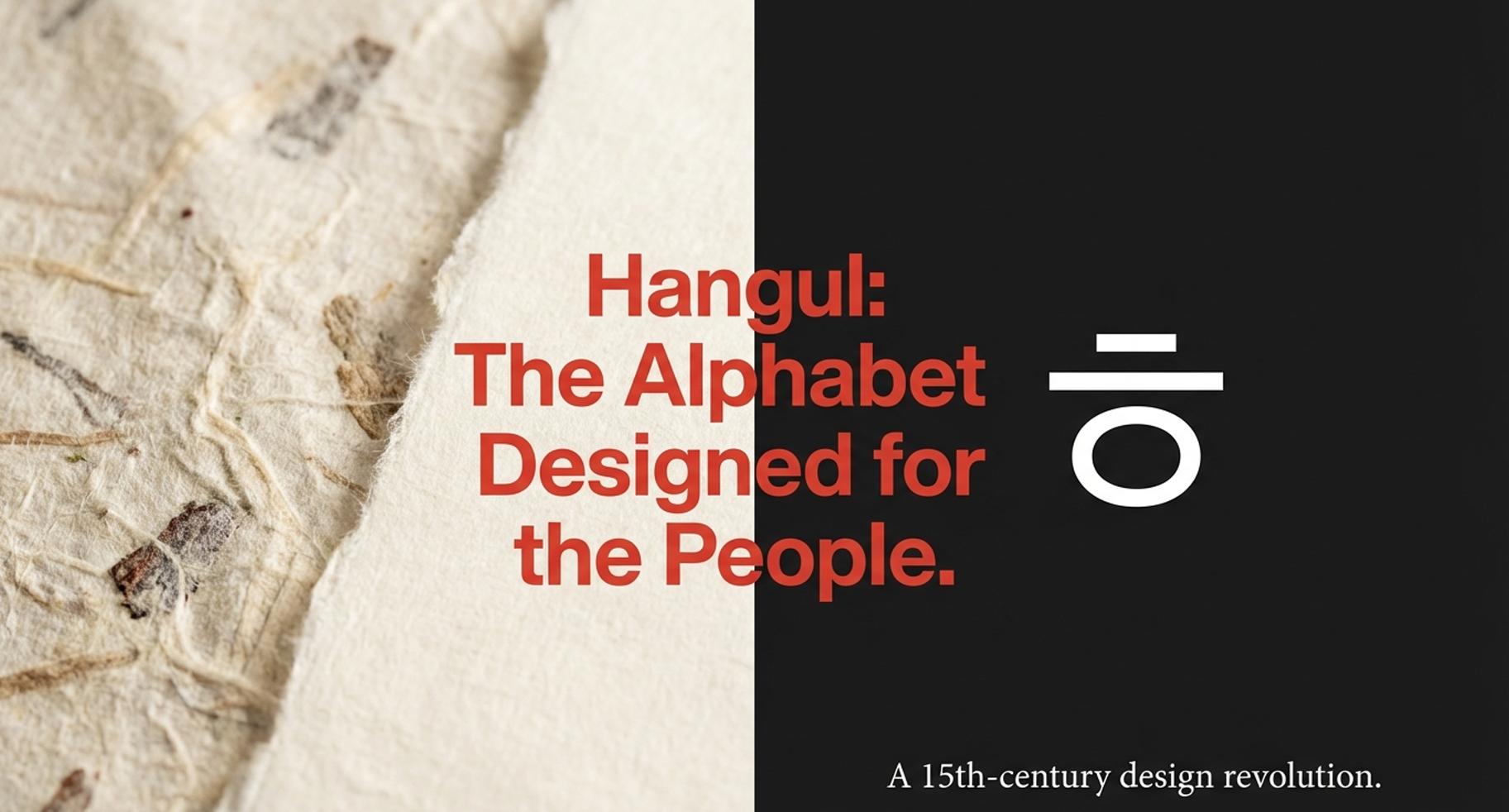
Created by King Sejong the Great in 1443, Hangul is the only alphabet in the world where the shape of the letters mimics the shape of your mouth and tongue when speaking!
What is Hangul?
Created in 1443 by King Sejong the Great, Hangul is the official writing system of Korea. Unlike many other writing systems that evolved over centuries, Hangul was deliberately designed to be easy to learn and efficient to use. It was originally called 'Hunminjeongeum', which means 'The Proper Sounds for the Instruction of the People'.
The Logic of Consonants
Hangul consonants are 'featural' symbols. This means their shapes actually mimic the position of the tongue, mouth, and throat when pronouncing them. For example, the letter 'ㄴ' (n) represents the tongue touching the upper gum, and 'ㅁ' (m) represents the shape of the lips.
The Harmony of Vowels
Hangul vowels are based on three fundamental elements of Eastern philosophy: Sky (·), Earth (ㅡ), and Humanity (ㅣ). By combining these simple elements, Hangul creates a rich palette of sounds that can represent almost any human vocalization accurately.
Why Learn Hangul First?
Most language learners find that they can read Hangul in just a few hours. Because it is purely phonetic, once you know the characters, you can pronounce any Hangul word correctly, even if you don't know its meaning yet. This provides a massive confidence boost for beginners!
Study Tips for Beginners
- ✅ Start with the basic 14 consonants and 10 vowels.
- ✅ Practice drawing the strokes in the correct order.
- ✅ Use our 'Hangul Rain' game to speed up your recognition.
- ✅ Listen to native speakers while reading the text.
Frequently Asked Questions
Q. How long does it take to learn Hangul?
Most students can learn to read the basic alphabet in just 1 to 2 hours. However, becoming fast at reading and typing takes a bit more practice through games like Hangul Rain.
Q. Is Hangul difficult to learn?
While the grammar can be different from English, the writing system (Hangul) is considered one of the easiest and most logical in the world.
Q. Do I need to learn Hanja (Chinese characters)?
No, Hangul is used for everything in modern Korea. While knowing some Hanja can help with advanced vocabulary, it is not necessary for daily life or starting your journey.
Q. What is the difference between Hangul and Hanja?
Hangul is the native Korean alphabet — 24 letters that map directly to sounds and combine into syllable blocks. Hanja are Chinese characters historically borrowed for vocabulary. Modern Korean is written almost entirely in Hangul; you may see Hanja used occasionally in newspapers, academic writing, and proper names, but you do not need it to read everyday Korean.
Q. Can I type Hangul on my computer or phone?
Yes — every modern operating system ships with a Korean input method. On Windows, add the Korean (Microsoft IME) keyboard from Settings → Time & Language. On macOS and iOS, enable Korean in the keyboard preferences. On Android, install Google Korean Input. You will type Romanized syllables and the system composes them into Hangul blocks automatically.
Q. Is Hangul written left-to-right or top-to-bottom?
Modern Hangul is written left-to-right in horizontal lines, just like English. Traditional Korean texts were sometimes written top-to-bottom in vertical columns, but this style is now reserved for calligraphy and certain ceremonial contexts. Inside a single syllable block, however, letters are composed both horizontally and vertically — that is what gives Hangul its distinctive square shape.
Q. Why do Korean syllables look like square blocks?
Hangul groups letters into syllable blocks instead of writing them in a single line. Each block contains an initial consonant, a vowel, and an optional final consonant, arranged so the block reads as one syllable. This design lets readers parse text faster — your eye recognizes the silhouette of each syllable, much like how English readers recognize whole words.
Q. In what order should I learn the consonants and vowels?
Start with the 10 basic vowels (ㅏ ㅑ ㅓ ㅕ ㅗ ㅛ ㅜ ㅠ ㅡ ㅣ) — they are pronounced exactly as written and give you traction quickly. Then move to the 14 basic consonants (ㄱ ㄴ ㄷ ㄹ ㅁ ㅂ ㅅ ㅇ ㅈ ㅊ ㅋ ㅌ ㅍ ㅎ). Once you can pair any consonant with any vowel, the rest of Hangul — double consonants, complex vowels, and final consonants — follows in a few hours.
Learning Articles
Hangul Learning Guide
Longer reads on the parts of Hangul that repay a closer look — one topic at a time, written for people who are actually learning it.